· by Madison
What Is the Science of Reading? A Real Breakdown for Teachers
The Science of Reading explained clearly — what it actually means, the five pillars, and what it looks like in your K–3 classroom. No jargon, no fluff.
At some point in the last few years, someone said "Science of Reading" in a staff meeting and half the room nodded like they knew exactly what it meant.
The other half Googled it in the parking lot.
If you're in that second group — or even the first group, but you're not totally sure what it actually looks like on Monday morning — this post is for you.
I'm going to break down what the Science of Reading really is (not the buzzword version), what it means for your classroom, and the specific skills you need to be teaching explicitly if you want your students to actually learn to read. Not "exposure." Not "rich literacy environments." Actually learn.
Let's get into it.
What the Science of Reading Actually Is (The Honest Version)
The Science of Reading isn't a curriculum. It isn't a program. It isn't even a teaching style.
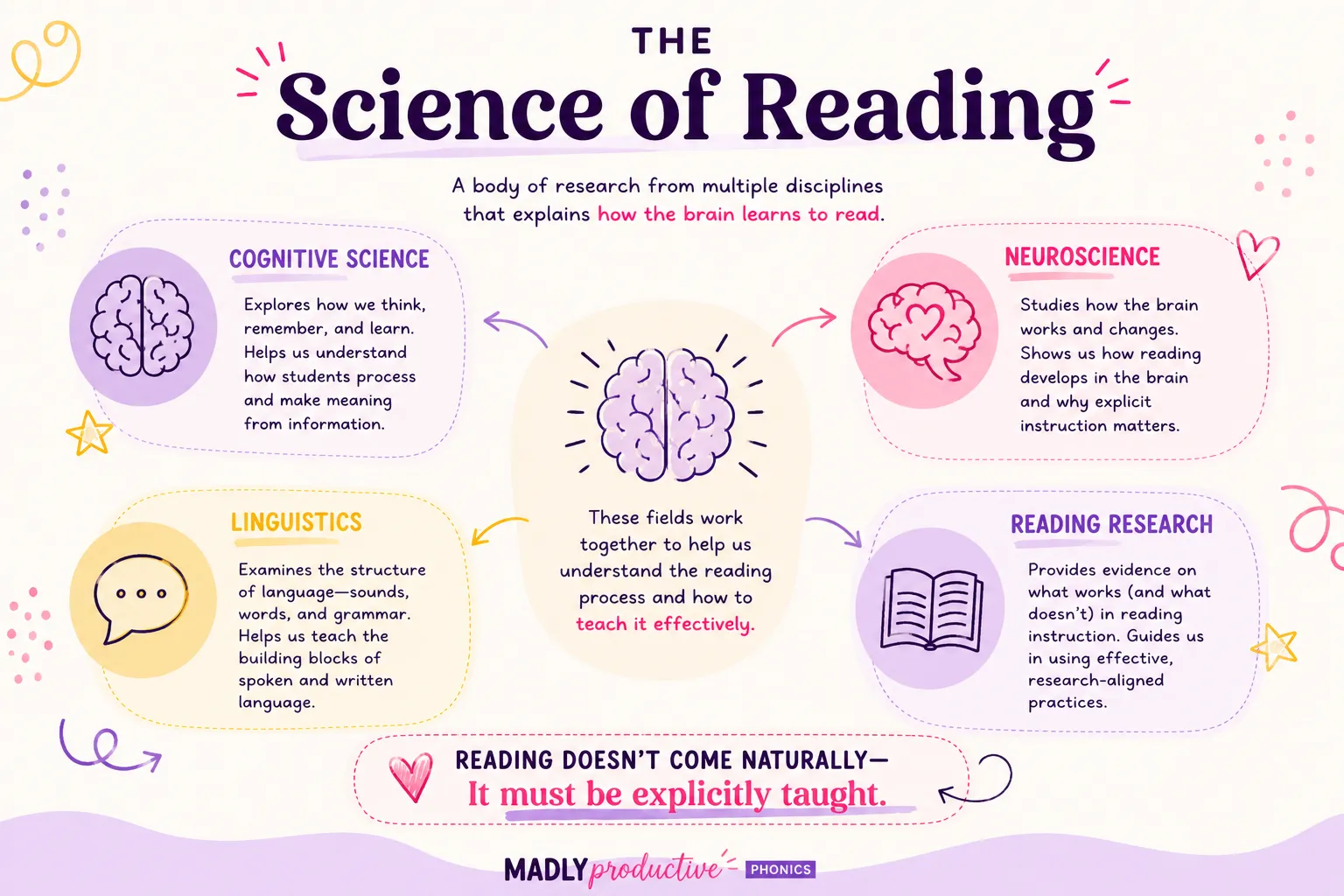
It's a body of research — decades of it — from cognitive scientists, neuroscientists, linguists, and reading researchers who studied how the human brain actually learns to read. And what they found is that reading doesn't come naturally to us the way speaking does. The brain isn't wired to read at birth. Reading is a skill that has to be explicitly taught, in a specific way, for it to stick.
That specific way is structured literacy — systematic, sequential, explicit instruction in the foundational skills that make reading possible.
Here's the part that stings a little: a lot of what many of us were taught to do — guided reading with leveled books, cueing strategies ("does it look right? sound right? make sense?"), relying on context clues and picture cues to "read" — doesn't align with how reading actually develops in the brain. Kids don't decode by guessing. They decode by mapping sounds to print, automatically, at the letter and syllable level.
That's not an attack on teachers. Most of us were taught using methods that just weren't supported by the research. Now the research is impossible to ignore.
So when someone says "Science of Reading," what they really mean is: teach reading the way the brain actually learns it.
The Five Pillars of Reading (And Why All Five Matter)
The foundational framework that most SOR-aligned instruction is built on comes from the National Reading Panel's report, which identified five essential components of effective reading instruction. You've probably seen these before, but let's be real about what they actually mean in practice.
1. Phonemic Awareness
Phonemic awareness is the ability to hear, identify, and manipulate individual sounds — phonemes — in spoken words. This is purely oral. No letters yet. Just sound.
Can a student clap out the sounds in "cat"? Can they tell you that "cat" and "mat" share the same ending sounds? Can they blend /k/ /æ/ /t/ together and tell you it says "cat"?
This is where reading actually starts — not with the alphabet, not with sight words. With sound.
Most teachers rush past phonemic awareness because it doesn't look like "reading." But if students can't segment and blend sounds orally, phonics instruction won't stick the way it should. Sound-to-print mapping only works when the sounds are solid first.
→ Want to know how to teach phonemic awareness before kids ever see a letter? [link to phonemic awareness sub-post]
2. Phonics
Phonics is the relationship between sounds (phonemes) and the letters or letter combinations that represent them (graphemes). This is where you're making the sound-to-print connection explicit.
SOR-aligned phonics instruction is:
- Systematic — following a logical scope and sequence, not random
- Explicit — directly taught, not discovered through exposure
- Cumulative — each new skill builds on the ones before it
The progression matters. You don't teach vowel teams before CVC. You don't introduce blends before students have solid letter-sound correspondence. There's an order, and the order is intentional.
→ Grab my free phonics resources in the resource library — includes decodables, phonics practice sheets, and differentiated tools organized by skill level. [link to freebie library]
3. Fluency
Fluency is reading accurately, at an appropriate rate, with expression. It's the bridge between decoding and comprehension.
Here's where a lot of teachers get stuck: fluency isn't just "reading fast." A student can read quickly and still not be fluent. Fluency means automaticity — decoding has become effortless enough that the brain's cognitive resources are freed up to think about meaning.
You build fluency through repeated reading of decodable and connected text at the student's instructional level. Leveled readers without decodability — where students are essentially guessing half the words — don't build fluency. They build guessing.
→ How to use decodable passages to build fluency the right way [link to decodable passages sub-post]
4. Vocabulary
Vocabulary instruction in a Science of Reading framework isn't a word wall with 20 random words on it. It's intentional, explicit teaching of Tier 2 and Tier 3 words — words that are academic, cross-subject, and high-utility — embedded in rich text and discussion.
Students who struggle to read are often also behind on vocabulary, because they've been read to less and read independently less. Vocabulary instruction can't wait until comprehension is solid. It needs to run parallel.
5. Reading Comprehension
Here's the thing about comprehension: if phonics, phonemic awareness, fluency, and vocabulary are all working, comprehension usually follows. Comprehension struggles in early readers are very often decoding struggles in disguise.
That doesn't mean you ignore comprehension instruction. But it means you don't skip to comprehension strategies when the foundation isn't there yet. You can't comprehend text you can't decode.
The Simple Model You Need to Know
If you've been to any SOR-related PD in the last few years, you've probably heard of Scarborough's Reading Rope. It's a model developed by reading researcher Hollis Scarborough that shows reading as two intertwined strands:
Language comprehension — background knowledge, vocabulary, language structure, verbal reasoning, literacy knowledge
Word recognition — phonological awareness, decoding, sight recognition
Both strands weave together to create skilled, fluent reading. And here's the important part: if either strand is weak, the whole rope is weak. You can't compensate for a word recognition deficit with strong comprehension skills, and vice versa.
Most reading difficulties in K–3 come from the word recognition strand. That's the phonemic awareness, phonics, and fluency work. That's where your instruction needs to be explicit, systematic, and relentless.
What This Actually Looks Like in Your Classroom
Okay, so what does SOR-aligned instruction actually look like on a Tuesday morning?
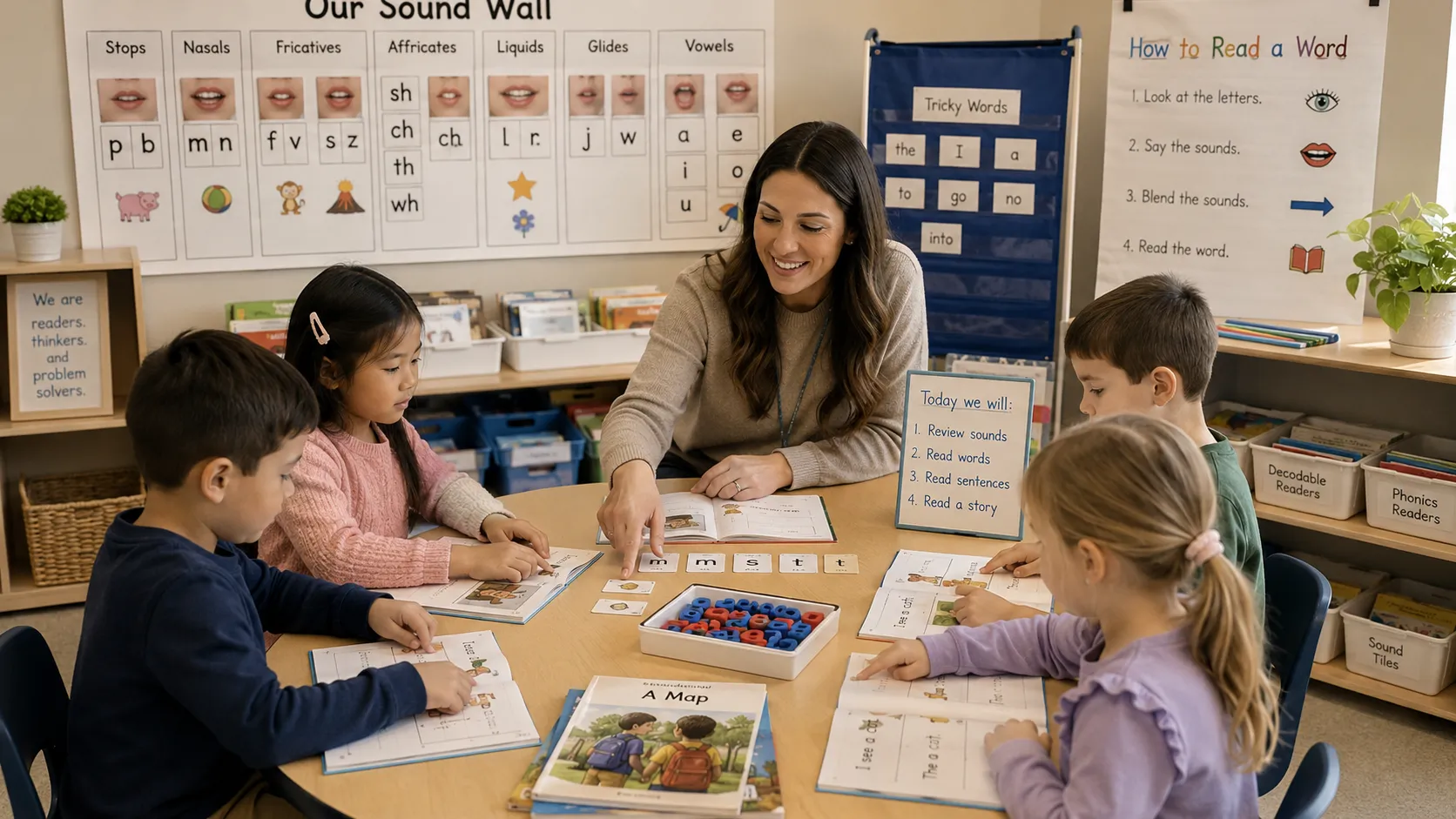
It looks like a phonics lesson with a clear skill focus — not "we're reading today" but "today we're practicing CVC words with short A."
It looks like a phonemic awareness warm-up before you introduce print — 2 to 3 minutes of blending and segmenting sounds orally before students ever see a letter.
It looks like decodable texts that are matched to the phonics skills your students have already been taught — not leveled books where kids are guessing based on the picture.
It looks like small groups where you're teaching to the specific skill gap, not just having kids read at "their level" and hoping something sticks.
It looks like explicit instruction: "Today we're learning that when two vowels go walking, the first one does the talking. Watch me. Now let's try it together. Now you try it on your own."
I, We, You. That's the structure. Model it. Do it together. Release gradually. Let them own it.
This is what I learned working at Ignite Reading, where every tutor was trained in the Walpole and McKenna framework for differentiated reading instruction. The reason it works is because it's the same lesson structure, the same progression, every single time — so students know what to expect, and instruction can focus on the skill, not the management.
It doesn't have to be complicated. Consistency beats complexity every time.
The Phonics Progression — In Order
If you're building or restructuring your phonics instruction, here's the sequence to follow. This isn't arbitrary — it moves from simple to complex, and each skill prepares students for the next.
- Phonemic awareness — oral only, no print (blending, segmenting, isolation)
- Letter-sound correspondences — consonants first, then short vowels
- CVC words — consonant-vowel-consonant (cat, hop, sit, bed, bug)
- Consonant blends — CCVC and CVCC (slip, frog, best, lamp)
- Digraphs — ch, sh, th, wh, ph (two letters, one sound)
- CVCe / Silent E — long vowel patterns (cape, bike, note, cute)
- Vowel teams — ai, ea, oa, ue, and others
- R-controlled vowels (Bossy R) — ar, er, ir, or, ur
- Diphthongs and other advanced patterns
- Multisyllabic decoding
Most K–2 classrooms should be working through steps 1–6. If your students are in second or third grade and still struggling with CVC words, that's where you go back — not to harder skills, but to the foundation.
→ Teaching each of these skills:
- [How to Teach CVC Words Step by Step]
- [How to Teach Digraphs]
- [How to Teach Blends]
- [How to Teach Silent E / CVCe Words]
- [How to Build Fluency with Decodable Passages]
The Biggest Shifts SOR Asks You to Make
Let me be direct. These are the things that change when you take the Science of Reading seriously.
You stop using the three-cueing system. No more "does it look right, sound right, make sense?" Those cues teach students to skip over words they don't know rather than decode them. You teach decoding instead.
You move away from leveled readers as the primary text. Leveled readers often include words that students haven't been taught to decode yet, which means students are guessing. Decodable texts match the phonics skills students have already learned.
You make phonics instruction explicit and sequential. Not integrated as a side note. Not "we'll figure out the pattern from the text." Explicitly taught, in a clear sequence, with practice until it's automatic.
You treat phonemic awareness as a non-negotiable warm-up. Even for kids who seem to "know their letters." Sound work first, always.
You differentiate based on phonics skill, not reading level. Students who are behind don't need "lower level" books. They need instruction matched to where they are in the phonics progression.
Does This Mean Everything You've Been Doing Is Wrong?
No.
There are teachers who've been doing a lot of this intuitively for years — explicit phonics work, structured routines, decodable practice. SOR isn't brand new teaching. It's research that confirms what works and challenges what doesn't.
And yes, some things need to shift. But the shift isn't about starting over. It's about being more intentional — knowing why you're teaching what you're teaching, and making sure the sequence and methods match how reading actually develops in the brain.
You don't have to overhaul everything overnight. Start with making your phonics instruction more explicit. Add phonemic awareness warm-ups. Introduce decodable texts alongside leveled ones. Small, consistent changes compound.
Where to Start This Week
If you want to bring more Science of Reading-aligned practice into your classroom right now, here's what I'd recommend:
- Grab the free resources in the library — phonics worksheets, decodable passages, and intervention tools organized by skill level. Sign up below to get the password. [Freebie library opt-in]
- Audit your phonics sequence — look at what you're teaching and whether it follows a systematic progression. If it feels random, it probably is.
- Add a 3-minute phonemic awareness warm-up to every phonics lesson. Oral only, no print. Segment and blend the sounds in 5–10 words connected to your phonics skill of the day.
- Try one decodable passage this week matched to a skill your students have already been taught. See what happens when they can actually decode every word on the page.
The goal isn't perfection. The goal is to make sure the students who are sitting in front of you get the instruction their brains actually need.
That's what this whole thing is about.
Questions? I read every message. Reach me at madison@madlyproductivephonics.com
— Madison

Keep reading:
- [How to Teach CVC Words Step by Step]
- [How to Teach Phonemic Awareness Before Kids See a Letter]
- [How to Run a Phonics Small Group That Actually Works]
- [What Are Decodable Passages and How Do I Use Them?]
Keep reading